Trade show and Xiaomi tour
Day 1 of the Austrade tour started with the official opening by senior members of the Chinese Bureaucracy. John Grimes was in an official photo with the Number 3 man of the Govt bureaucracy. Not everyone gets in those official photos and it was a tribute to the work he has put in over many years building up the relationship between China and Australia.
After several speeches I did some sight seeing and thus missed my first call for the “pitch” session where those of us that wanted to spruiked our products to an Audience and and then had a speed dating session of individual introductions. I managed to make it to the end of the show and did my two minute pitch and ended up with lots of WeChat contacts and business cards. I’d be surprised if any business resulted but I’ll follow up when I get time.
Then there was the official dinner for maybe 300 people in the Crowne Hotel and Western style steak and some excellent desert, the fist decent sweet I’ve had on tour.
Chinese people do take sugar but I’m told it’s mainly in milk products whereas I dislike sweet milk and prefer my biscuits and chocolate. In any event they mostly seem far less overweight than many westerners. That said my fellow delegates are a fit and healthy bunch by the look of them.
The next day we we went on a guided tour of parts of the show, looking at Xpeng ( I drive one) but it was interesting to see their personal use VTOL (drone helicopter) and the vehicle that carries it. It’s not yet in production but they have 8000 pre orders. Given Beijing traffic I can understand that.
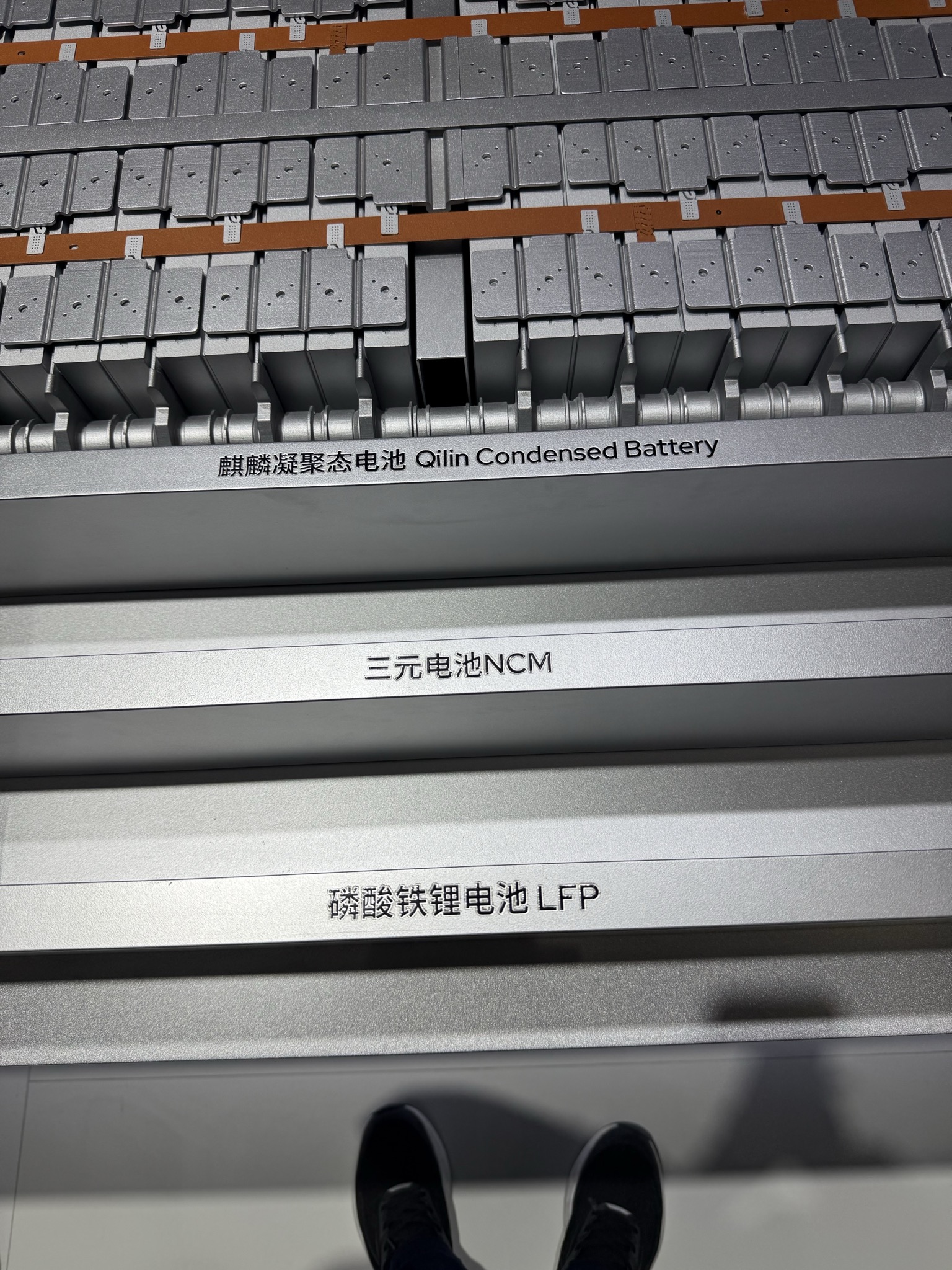
Also of interest to me was the CATl stand where it was really interesting to see their various different chemistries in packs and their different use cases. Some designed specifically for fast charging trucks in very cold conditions, due to lightest battery with high performance for up market cars. It’s amazing to see their volume reduction the 2026 QLIN battery has compared with the LFP chemistry in many EVs. The vast majority of EV buyers wont see or care about the differences.
I’ve put some commentary on CATL and BYD in at the end.
In the afternoon we went to the Xiaomi factory. The Xiaomi is the Chinese flagship ev even though it’s expensive and far from the biggest volume. It’s models look great, have incredible performance, We could go for a test as passengers on the local circuit if desired. They are packed with technology. We also toured the factory where a car rolls off the “line” in 76 seconds. Next time you hop in your EV ponder on it probably having been built in 2 minutes or less. Nio can do about 35 seconds.
Of course all the subassemblies had to be done first and production runs in the 100s of thousands a year.
The factory was full of robots, but not just stationary ones doing welding etc. There were also “trays” on wheels operating semi autonomously carrying parts from one section to another.
This mirrored an automated stacking system I saw at the trade show. Cheap and like a big seller for any where house with a lot of inventory capable of being stacked.
No photos of the Xiaomi and it’s not being exported. It would sell like hot cakes in Australia.
The factory does non stop tours demonstrating that as well as cars there is a “propaganda” element. That’s ok. It’s a powerful demo.
Today its National Grid in the morning (the worlds biggest electricity company) and then high speed train to a region near Shanghai. Big day as usual.
Photos to follow if I get time. There aren’t any ones of general interest.
battery suppliers
Here’s the picture, with the important caveat up front: the headline SNE Research figures below are EV (automotive) installations only — they exclude stationary storage, where CATL is also the global #1 and the gap over BYD is even wider. So this understates CATL’s total battery footprint relative to BYD.
Relative size (EV battery installations, SNE Research)
For full-year 2025: CATL installed 464.7 GWh for a 39.2% share — the only supplier above 30% — while CATL and BYD combined reached 659.5 GWh, or 55.6% of the global total . That puts BYD around 195 GWh / 16.4%.
The 2026 run-rate has widened the gap. For Jan–Apr 2026, CATL hit 141.4 GWh (40.1%, up 19.8% YoY) while BYD fell to 50.0 GWh (14.2%, down 2.4%) . So CATL is now roughly 2.8x BYD on EV installations and pulling away — BYD is the only top-two player shrinking in absolute terms in a market growing ~14%.
The divergence is structural, and it goes straight to your vertical-integration question: BYD’s captive supply model primarily serves its own vehicles, and its mix has shifted toward plug-in hybrids with smaller packs, whereas CATL supplies a broad range of global OEMs and is growing its external base . SNE attributes BYD’s slide directly to sluggish sales of its own-branded vehicles in China weighing on battery usage . That’s the tell: BYD’s battery numbers rise and fall with BYD’s car sales, because most cells are consumed internally.
CATL — strengths and weaknesses
Strengths: scale and cost leadership; a true merchant model selling to nearly everyone (Tesla, BMW, Ford, VW, NIO, Li Auto, Zeekr, Xiaomi premium); and the broadest technology portfolio — NMC (Qilin), LFP (Shenxing), the new Naxtra sodium-ion, and the condensed/semi-solid line. Crucially, it doesn’t build cars, so OEMs treat it as a neutral supplier. It’s also #1 in grid storage.
Weaknesses: geopolitical exposure is the big one — US scrutiny, IRA/tariff friction, and the political awkwardness of Western OEMs depending on a Chinese leader. It’s also demand-taker rather than demand-owner: no captive vehicle volume to guarantee offtake.
BYD — strengths and weaknesses
Strengths: deepest vertical integration in the industry — cars, cells, power semiconductors, and partial upstream material processing — giving end-to-end cost control and guaranteed captive demand as the world’s largest NEV maker. The Blade (LFP) battery is a strong safety/packaging/cost story.
Weaknesses: largely LFP-only with no high-end ternary product to match Qilin (as we discussed); the battery business is mostly captive, so external merchant share is thin; and being a carmaker is a conflict for would-be battery customers.
On your specific observation
You’re right that integration hasn’t prevented external sales — but it constrains them, and BYD had to engineer around the conflict. It spun the battery unit into an arm’s-length entity, FinDreams Battery (Fudi), precisely to reassure rival OEMs that buying cells wouldn’t be funding a direct competitor. It does supply outsiders — Tesla, Toyota (via JV), Ford, and notably Xiaomi — but the Xiaomi case is the perfect illustration of the limit: Xiaomi’s lower model uses BYD’s Blade while the premium 800V model uses CATL’s ternary Qilin . The merchant business is real but secondary; the bulk still goes into BYD’s own cars. CATL’s neutrality is exactly why it captures the lion’s share of the third-party market — an OEM choosing a supplier would generally rather not hand margin and roadmap visibility to a company that competes with it on the showroom floor.